
When your business retires old computers, servers, and electronics, the question of who handles them matters more than most people realize. Hand your equipment to the wrong recycler — one without verified certification — and you're exposed to data breach risk, downstream environmental liability, and the possibility that your "recycled" equipment ended up in a landfill or an informal processing operation overseas.
The single most important thing to verify when choosing an electronics recycler is whether they hold R2V3 certification. It's the gold standard of the industry, independently audited, and the clearest signal that a recycler has been verified — not just self-declared — to handle your equipment responsibly.
Here's everything you need to know about what R2V3 certification is, what it actually requires, and why Houston businesses should ask for it before handing over a single device.
What Is R2V3 Certification?
R2V3 stands for Responsible Recycling, Version 3. It is the current version of the R2 standard, developed and maintained by SERI — the Sustainable Electronics Recycling International organization. R2V3 is the most widely adopted certification standard for electronics recyclers and IT asset disposition providers in the United States and internationally.
The key word is certification — not self-declaration, not membership, not a logo on a website. R2V3 certified facilities have been audited by an accredited, independent third-party certification body that verified the facility meets all requirements of the standard. Certification must be renewed annually, which means the audit is ongoing, not a one-time event.
The plain-English version: R2V3 means an independent auditor — someone with no financial relationship with the recycler — visited the facility, reviewed their processes, tested their documentation, and confirmed they meet the standard. If a recycler says they're R2V3 certified, you can verify it yourself in the public SERI database at sustainableelectronics.org.
What Does R2V3 Actually Require?
R2V3 is a comprehensive standard covering four major areas. Understanding what's required helps you appreciate what certification actually means — and what you're protected from when you use a certified facility.
🔒 Data Security
R2V3 requires certified facilities to have documented, audited processes for data destruction. This includes NIST 800-88 compliant sanitization methods, chain-of-custody controls, and serialized documentation. Data security practices must be tested and verified during the audit — not just described in a policy document.
🌿 Environmental Responsibility
Certified facilities must have an ISO 14001-aligned environmental management system, document all downstream material flows, ensure downstream vendors meet minimum standards, and demonstrate responsible handling of hazardous materials including mercury-containing devices, batteries, and CRTs.
👷 Worker Health & Safety
R2V3 requires certified facilities to maintain a documented health and safety management system, conduct regular safety training, provide appropriate protective equipment, and demonstrate compliance with applicable occupational health regulations. Worker safety is audited, not assumed.
📋 Downstream Accountability
This is one of R2V3's most important requirements. Certified facilities must know where their materials go — every downstream processor must be identified, vetted, and documented. This chain of accountability is what prevents certified recyclers from laundering equipment into irresponsible channels after it leaves the facility.
What the Annual R2V3 Audit Actually Covers
The annual R2V3 audit is not a paperwork exercise. An accredited auditor physically visits the facility and examines operations across multiple areas:
- Facility Inspection
The auditor walks the facility, observing actual equipment handling practices, storage conditions, separation of hazardous materials, and worker safety measures. What happens on the floor matters as much as what's written in the policy manual. - Data Destruction Verification
The auditor reviews data destruction processes, tests documentation practices, and verifies that chain-of-custody controls are functioning as documented. Certificates of Destruction are sampled and traced back to source equipment. - Downstream Vendor Review
Every downstream vendor used by the certified facility must be documented and verified. The auditor checks that downstream processors meet R2V3's minimum requirements — preventing certified facilities from passing equipment to irresponsible handlers after it leaves their dock. - Environmental Management Review
The auditor reviews the environmental management system, checks records of hazardous material handling, verifies proper disposal of regulated items (mercury lamps, batteries, CRT glass), and confirms legal compliance with environmental regulations. - Health & Safety Review
Training records, incident logs, protective equipment availability, and safety procedures are all reviewed. The auditor verifies that the facility's health and safety management system is active and functioning — not just documented and filed.
R2V3 vs. Other Certifications: How Do They Compare?
R2V3 is not the only electronics recycling certification, but it is the most widely adopted in the United States. Here's how it compares to the other major standards you may encounter:
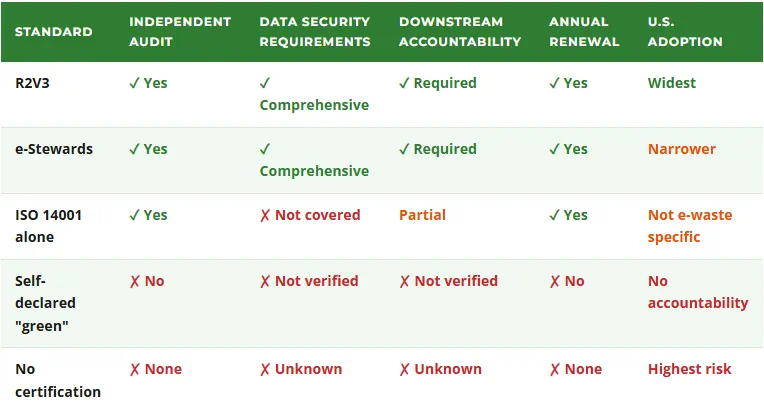
Both R2V3 and e-Stewards are legitimate, rigorous standards. If a recycler holds either certification, they have been independently verified. The meaningful distinction is between certified and uncertified — not between the two major certifications themselves.
Why R2V3 Matters for Your Business Specifically
It Protects You From Downstream Liability
Under U.S. environmental law, the original generator of electronic waste can retain liability for how that waste is ultimately handled — even after it leaves your facility. If your "recycler" passes equipment to an irresponsible downstream processor that dumps it in a landfill or ships it overseas to an informal operation, you may share in that liability.
R2V3's downstream accountability requirement exists precisely to break this chain. A certified facility has documented, audited accountability for where every material stream goes. That documentation protects you.
It Verifies Data Security Practices — Not Just Claims
Any recycler can claim they "securely wipe" drives. R2V3 certification means that claim has been independently tested and verified. The auditor checked the actual data destruction process, reviewed the documentation practices, and confirmed the chain-of-custody controls work as described. That's a fundamentally different level of assurance than a vendor's marketing copy.
It Supports Your ESG and Sustainability Reporting
Increasingly, investors, boards, and stakeholders ask businesses to demonstrate responsible environmental practices — including how they handle end-of-life electronics. A documented relationship with an R2V3 certified recycler provides the verification your sustainability team needs for reporting. It's auditable, traceable, and recognized by international sustainability frameworks.
Red Flags: What to Watch Out For
Not every electronics recycler operates to the same standard. Here are warning signs that should prompt you to ask harder questions — or walk away:
🚩 They claim certification but can't provide a certificate number
R2V3 certified facilities have a certificate number you can verify in the SERI public database. If a recycler claims certification but can't provide a verifiable certificate, treat the claim as unverified.
🚩 They can't tell you where materials go after processing
Downstream accountability is a core R2V3 requirement. A certified recycler can and should be able to tell you who their downstream vendors are and confirm they meet minimum standards. Vague answers here are a serious concern.
🚩 They offer to take your equipment for free with no documentation
Free pickup with no paperwork is a red flag. Legitimate certified recyclers provide manifests, chain-of-custody documentation, and Certificates of Destruction. If the process involves handing over equipment with nothing in return, you have no protection.
🚩 They provide batch Certificates of Destruction, not serialized ones
A legitimate Certificate of Destruction is tied to an individual device's serial number. A batch certificate that covers 200 devices with a single document doesn't prove any specific device was destroyed — it just proves someone signed a form.
🚩 Their certification is expired or lapsed
R2V3 certification requires annual renewal. Always check the SERI database directly — don't rely on a logo on a website that may not have been updated when certification lapsed.
How to Verify R2V3 Certification
Verifying a recycler's R2V3 certification takes about 60 seconds and should always be done before engaging a new vendor. Here's how:
- Go to sustainableelectronics.org — SERI's official website
- Navigate to the certified facilities directory
- Search by company name, city, or state
- Confirm the certification is current — check the expiration date
- Confirm the scope of certification covers the services you need (some facilities have limited scope certifications)
This is public information. Any legitimate R2V3 certified facility will be listed. If a vendor claims certification but doesn't appear in the database, their claim is not verified.
Altech's Certifications
Altech has maintained responsible recycling certification at our Houston facility since achieving R2 status, and we have upgraded to the current R2V3 standard. We are also ISO 9001, ISO 14001, and ISO 45001 certified — independently audited standards covering quality management, environmental management, and occupational health and safety, respectively.
R2V3
Certified Recycler
ISO 9001
Quality Management
ISO 14001
Environmental Management
ISO 45001
Occupational Safety
NIST 800-88
Data Destruction
You can verify our R2V3 certification directly through the SERI certified facility directory. We encourage every client to do so — because a recycler that welcomes verification is one you can trust.
Work With a Verified R2V3 Certified Recycler in Houston
Altech is R2V3 certified, independently audited, and has been handling electronics responsibly in Houston since 1984. Schedule a free assessment for your business today.
Frequently Asked Questions About R2V3 Certification
What is R2V3 certification?
R2V3 (Responsible Recycling, Version 3) is the leading certification standard for electronics recyclers and ITAD providers, developed by SERI. It requires certified facilities to meet rigorous independently audited standards covering data security, environmental responsibility, worker health and safety, and downstream accountability. Certification is renewed annually.
What does R2V3 certified mean?
An R2V3 certified recycler has been audited by an accredited independent third party and verified to comply with the full R2V3 standard. It means the certification is not self-declared — an independent auditor physically visited the facility and confirmed processes, documentation, and downstream accountability meet the standard's requirements.
What is the difference between R2 and R2V3?
R2V3 is the current version of the standard, replacing the previous R2:2013. R2V3 introduced stronger data destruction documentation requirements, more rigorous downstream accountability, enhanced environmental management requirements, and stricter worker safety provisions. All newly certified facilities certify to R2V3.
How do I verify a recycler is R2V3 certified?
Search the SERI certified facility directory at sustainableelectronics.org. This public database lists all currently certified facilities with certification status and expiration dates. Always verify directly rather than relying solely on a vendor's self-reported claims or website logos.
Is Altech R2V3 certified?
Yes. Altech is R2V3 certified and has maintained responsible recycling certification since achieving R2 status. Our Houston facility is independently audited annually. You can verify our current certification status through the SERI certified facility directory at sustainableelectronics.org.

