
When a company retires a computer, the data on that device doesn't disappear on its own. Someone has to destroy it — and someone has to prove it was destroyed. That proof is a Certificate of Destruction.
Most businesses have heard the term. Far fewer understand exactly what a valid Certificate of Destruction contains, why the details matter enormously, and what the difference is between a document that actually protects them and one that provides only the appearance of protection. This guide covers all of it — what a CoD is, what it must include, who needs one, and what to watch out for.
What Is a Certificate of Destruction?
A Certificate of Destruction (CoD) is a formal document issued by a certified data destruction or ITAD provider confirming that a specific piece of equipment has had its data permanently and irrecoverably destroyed. It is the paper trail that proves — to auditors, regulators, legal teams, and your own compliance officers — that a specific device no longer contains recoverable data.
Think of it as a receipt for data destruction. Just as you keep a receipt when you pay a bill, you keep a Certificate of Destruction when data is eliminated. If anyone ever asks what happened to the data on a specific device — and in regulated industries, someone eventually will — the CoD is your answer.
The plain-English definition: A Certificate of Destruction is your documented, signed proof that a named device had its data permanently destroyed on a specific date using a specific method. It is the difference between saying "we had everything wiped" and being able to prove it for any individual device under scrutiny.
What a Valid Certificate of Destruction Must Include
Not all Certificates of Destruction are created equal. A document that's missing critical fields provides far less protection than it appears to. Here's what every valid CoD must contain:
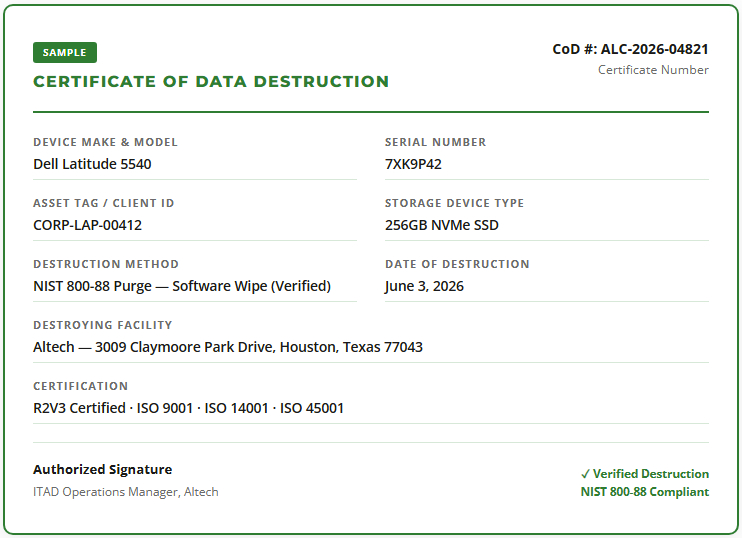
Every field in that sample document serves a purpose. The serial number is the most critical — it's what ties this certificate to a specific, identifiable device. Without it, the document can't prove any particular machine was destroyed, only that some destruction happened somewhere.
Serialized CoD vs. Batch CoD: A Critical Distinction
This is where many businesses get caught out — and where some ITAD vendors fall short without the client realizing it.
✓ Serialized Certificate of Destruction
✓ Tied to an individual device's serial number
✓ Can prove any specific device was destroyed
✓ Auditors can trace it back to a single machine
✓ Satisfies HIPAA, GLBA, FERPA audit requirements
✓ Defensible in litigation and regulatory review
✗Batch Certificate of Destruction
✗ Covers multiple devices in one document
✗ Cannot prove any specific device was destroyed
✗ If a device goes missing, there's no individual record
✗ Insufficient for regulatory audits in most industries
✗ Provides appearance of protection, not proof
The difference matters enormously in practice. Imagine a healthcare organization receives a batch CoD covering 200 laptops. Months later, an OCR investigator asks for proof that a specific laptop — serial number 7XK9P42, assigned to a nurse who had access to patient records — was properly destroyed. A batch document can't answer that question. A serialized CoD can.
Who Legally Needs a Certificate of Destruction?
In practice, every business that retires equipment containing sensitive data should have CoDs on file. But for regulated industries, it isn't just best practice — it's part of demonstrating legal compliance. Here's how it breaks down across the major sectors:
HIPAA
Healthcare
HIPAA requires covered entities to protect PHI through its full lifecycle including disposal. The HHS Office for Civil Rights expects to see documented evidence of proper disposal during audits and breach investigations. A serialized CoD for every device is the standard of care.
GLBA SAFEGUARDS RULE
Banking & Financial Services
The FTC's updated Safeguards Rule requires financial institutions to implement and document formal policies for the disposal of customer information. Examiners from the OCC, FDIC, and state banking regulators ask for disposal documentation during examinations.
FERPA
Education
FERPA protects student records throughout their lifecycle. School districts and universities retiring Chromebooks, laptops, and servers need CoDs to document that student PII was destroyed before devices left their control — particularly important for 1:1 device programs.
NERC CIP-011
Energy & Utilities
Grid operators and utilities must document the disposal of BES Cyber System information under NERC CIP-011. Certified chain-of-custody documentation including CoDs is required for compliance and subject to NERC audit.
STATE PRIVACY LAWS
All Industries
Texas, California, New York, and dozens of other states have data protection laws requiring reasonable measures to protect personal information. CoDs documenting proper destruction demonstrate those measures were taken.
GENERAL BEST PRACTICE
All Businesses
Even without specific regulatory requirements, any business handling employee data, customer records, financial information, or proprietary data should have CoDs for all retired devices. It's the documentation that protects you if questions arise later.
What Destruction Methods Should Appear on a CoD?
A valid Certificate of Destruction should specify which destruction method was applied. The three main methods recognized under NIST Special Publication 800-88 — the federal standard for media sanitization — are:
- Clear — Software overwrite of all addressable locations. Appropriate for devices staying within your organization. Less common on CoDs for third-party disposal.
- Purge — Advanced sanitization including cryptographic erasure or verified multi-pass overwriting that protects against laboratory-level recovery. The standard method for devices leaving your organization's control.
- Destroy — Physical destruction rendering the device completely unusable. Includes shredding (drives reduced to fragments of 2mm or smaller for the highest security classification), degaussing, and disintegration. Required for the most sensitive data classifications and for devices that cannot be reliably sanitized.
The CoD should state which of these was applied and, ideally, reference NIST 800-88 compliance specifically. A CoD that says only "data wiped" without specifying the method and standard is less defensible than one that cites the specific method applied.
How Long Should You Keep Certificates of Destruction?
The standard recommendation is a minimum of seven years — which aligns with common statute of limitations timelines and federal audit lookback periods. Some industries have specific requirements:
- Healthcare: Retain CoDs for as long as the associated patient records retention period — often longer than seven years for certain record types
- Financial services: Follow your applicable record retention schedule — typically five to seven years minimum
- Education: Align with FERPA record retention requirements for the associated student records
- All businesses: Store digitally — CoDs take up no physical space and having them years later costs nothing
The risk of keeping CoDs too long is essentially zero. The risk of not having them when you need them — during an audit, a breach investigation, or litigation — can be significant. When in doubt, keep them.
What to Ask Your ITAD Provider About CoDs
Before you engage any data destruction or ITAD vendor in Houston or anywhere else, ask these questions specifically:
- Do you provide a serialized Certificate of Destruction for every individual device, tied to its serial number?
- What destruction method do you use, and does the CoD reference NIST 800-88 compliance?
- How quickly after destruction do I receive the CoD?
- Are you R2V3 certified — and can I verify that in the SERI database?
- Can you provide sample CoDs so I can review the format before committing?
- Do you maintain copies of CoDs and can you retrieve them if I need a duplicate?
A vendor who answers all of these questions confidently and completely — and welcomes verification — is operating to the right standard. Hesitation or vague answers on any of these points should prompt closer scrutiny.
Altech's Certificate of Destruction Process
At Altech, we produce a serialized Certificate of Destruction for every data-bearing device — tied to the individual device's serial number, specifying the NIST 800-88 destruction method applied, dated, and signed.
We've been providing certified data destruction documentation to Houston and Gulf Coast businesses since 1984. Our CoDs have been accepted by HIPAA auditors, GLBA examiners, school board compliance officers, and corporate legal teams. They are formatted for real-world audit use — not just appearance.
Get Certified Data Destruction With Serialized CoDs for Every Device
Altech provides NIST 800-88 compliant data destruction and serialized Certificates of Destruction for businesses across Houston and the Gulf Coast. R2V3 certified. Serving businesses since 1984.
Frequently Asked Questions About Certificates of Destruction
What is a Certificate of Destruction?
A Certificate of Destruction (CoD) is a formal document confirming that a specific device has had its data permanently and irrecoverably destroyed. A valid CoD identifies the device by serial number, states the destruction method, the date of destruction, and is signed by an authorized representative of the certified destroying facility. It serves as your legal documentation that data was properly handled.
What should a Certificate of Destruction include?
A valid Certificate of Destruction must include the device make, model, and serial number; the destruction method used and its compliance standard (e.g., NIST 800-88 Purge); the date destruction was performed; the name, address, and certification of the destroying facility; and an authorized signature. It should be serialized to the individual device — not a batch document covering multiple devices without individual identification.
Is a Certificate of Destruction required by law?
For regulated industries, documented data destruction is required or strongly implied by law. HIPAA, the GLBA Safeguards Rule, FERPA, and NERC CIP-011 all require organizations to demonstrate that covered data was properly destroyed at end of life. A serialized Certificate of Destruction is the standard of care that regulators and auditors expect to see — and that protects you when they ask.
What is the difference between a serialized CoD and a batch CoD?
A serialized Certificate of Destruction is tied to a specific device's serial number, providing device-level proof of destruction. A batch CoD covers multiple devices in a single document without individual identification. Only serialized CoDs can prove that a specific named device was destroyed — which is what auditors, regulators, and legal teams require when questions arise about specific equipment.
How long should you keep a Certificate of Destruction?
Best practice is a minimum of 7 years, aligning with common statute of limitations and federal audit lookback timelines. Healthcare organizations should align with patient records retention periods. Financial institutions should follow their applicable record retention schedules. Store CoDs digitally — they take up no space and having them available years later costs nothing.

